Key Takeaways:
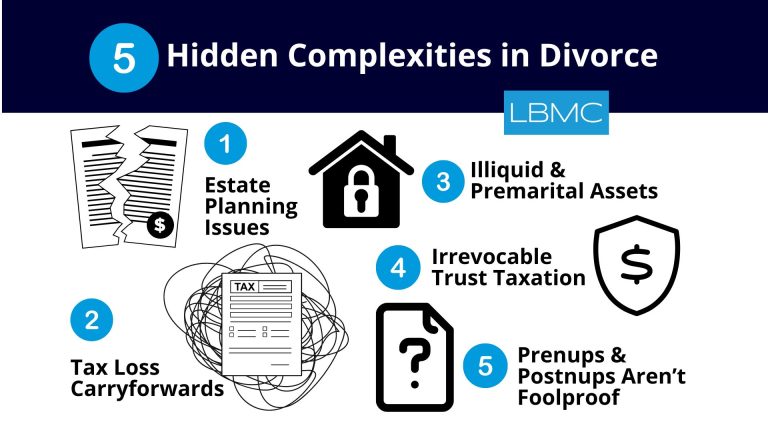
- Divorce Adds Complexity to Estate Planning: Divorce introduces unique challenges, such as continued tax liabilities for irrevocable grantor trusts like SLATs, where the grantor spouse remains responsible for taxes post-divorce.
- Tax Loss Carryforwards Complicate Asset Division: Tax loss carryforwards, including state and local, impact asset division. Understanding how these tax attributes transfer is key to ensuring an equitable settlement.
- Premarital and Illiquid Assets Need Special Attention: Premarital assets may be subject to division if mingled with marital funds, and illiquid assets can create cash flow issues, requiring creative financial solutions post-divorce.
Divorcing clients often believe their estate is simple and will lead to an easy division of the marital property. Families often spend time and resources on estate plans to simplify matters at death, and they conclude divorce will be similarly impacted. This may not be the case. While they may be right about much of their estate, high-net-worth divorce brings some different considerations that may increase financial complexity in the division of assets and debts that would not otherwise be part of the conversation.
How Divorce Can Affect the Taxation of Irrevocable Grantor Trusts
Clients who have established irrevocable grantor trusts such as SLATs, Spousal Lifetime Access Trusts, as an estate planning tool to move assets out of the estate while still providing access to them, know that the taxation of income related to the SLAT is reported as income on the marital tax return. SLATs are generally created by one spouse, the grantor, for the benefit of the other spouse, the beneficiary. This tax treatment is not problematic during the marriage as the income of the SLAT can be withdrawn to pay taxes and for other needs. However, practically speaking, the income is actually attributed to the grantor spouse who must pay the tax on the income.
The Tax Cuts and Jobs Act of 2017 repealed IRC Section 682 for post-2018 divorce agreements while leaving the grantor trust rules intact. As a result, the grantor spouse may remain liable for income taxes attributable to a trust benefiting a former spouse after divorce, depending on the trust’s structure and governing provisions. Addressing this in divorce is complex and often requires the involvement of financial and estate experts to attend to all of the repercussions of this unintended outcome.
How Tax Loss Carryforwards Are Treated in Divorce
Different assets can produce a variety of tax loss carryforwards such as capital loss carryforwards and net operating loss carryforwards. Tax loss carryforwards can have real cash value as they represent a potential offset of future tax liability. In general, divorcing couples cannot arbitrarily decide which of them will have the benefit of the loss carryforwards. Generally, tax loss carryforwards follow federal tax allocation rules and the ownership history of the assets that generated them, although treatment can vary depending on the type of carryforward, marital property laws and the terms of the settlement agreement.
Clients often forget that in addition to tax loss carryforwards at the federal tax level, there are often tax loss carryforwards at the state and local level. State and local tax loss carryforwards can take longer to utilize as they are applied to what is considered income earned for that state or locality. When considering the value of an asset, it is prudent to also consider the benefits of any tax loss carryforwards that might accrue to whomever is awarded the asset. Additionally, there may be a benefit to executing a sequence of steps to enable the spouses to fully utilize and benefit from tax loss carryforwards, depending on the intended settlement outcome. The right financial expert can help identify the tax loss carryforwards and assist with considering their impact and utilization in the divorce context.
Managing Illiquid Assets and Cash Flow in Divorce
Some high-net-worth estates include considerable illiquid assets. While the assets themselves may be awarded to one spouse or the other to affect an equitable division of the marital estate, it may not solve cash flow concerns for both spouses post-divorce. Creative planning may be necessary when one spouse has substantial assets but limited reportable income, creating challenges in meeting liquidity, financing or cash flow needs after divorce. Financial experts on the divorce team can help structure the division of property to address these needs while considering the broader financial implications for both spouses.
Protecting and Valuing Premarital Assets in Divorce
Spouses often enter marriage with considerable assets and may not have a prenuptial agreement that would help protect those assets in the event of divorce. They may believe what they brought into the marriage is undisputably theirs and there is no need for a prenuptial agreement. They may or may not be right.
Many jurisdictions recognize premarital assets, and potentially, the growth on those assets as the separate property of the owner-spouse. However, individuals sometimes change title of the assets to add their spouse, they may contribute marital funds to their premarital accounts, their spouse may be involved in managing and growing the assets, and there may be other considerations that muddy the water and make discerning the premarital value of assets challenging.
Those in long-term marriages also face the sometimes difficult hurdle of obtaining financial records that predate the marriage. Careful documentation and tracing of marital and separate assets can be critical when determining whether premarital property has retained its separate character or become part of the marital estate.
Financial Considerations for Prenuptial and Postnuptial Agreements
Frequently, those who have prenuptial or postnuptial agreements that govern the division of assets and debts in divorce believe their divorce will be easy and a mere formality. It depends. Such agreements may not address all circumstances that arise over time, particularly where family, business, financial or tax situations have evolved since the agreement was drafted. This can lead to an unintended consequence. And, if the spouses have not lived by the terms of the agreement, it may invalidate or muddy portions of the intended outcome. Financial experts can assist the divorce team in understanding the financial and tax implications of the agreements and their real-life execution in current-day circumstances, as well as advise on practical solutions to address concerns.
Getting Financial Expertise for a High-Net-Worth Divorce
These are just a few of the hidden complexities inherent in high-net-worth divorces. While the marital estate may appear easy to divide on the surface, divorce brings special considerations best addressed with the assistance of experts.
Shareholder Cheryl Panther and LBMC’s Family Law Support Services are ready to join your team and provide high-quality advice and creative thinking to the complexities of your situation.
Cheryl Panther is a Shareholder in LBMC’s Valuation and Litigation Support Services practice and co-leader of LBMC’s Family Law Support Services practice. She provides financial, tax, and analytical expertise for complex divorce matters and settlements.
LBMC, PC, is not a law firm and no portion of this website and associated blog content should be construed as legal advice. To the extent a reader has any questions regarding the applicability of any specific issue discussed herein to their individual situation, they are encouraged to consult with the professional adviser of their choosing.
Information included in this website and associated blog is for educational purposes only and is not intended as an offer or solicitation for the sale or purchase of specific securities, investments, or investment strategies. Investments involve risk and, unless otherwise stated, are not guaranteed. Please consult with a qualified financial adviser and/or tax professional before implementing any strategy discussed herein. Past performance may not be indicative of future results.