
Home » Services & Solutions » Cybersecurity » Technical Security Services
Technical Security Services
The most effective way to strengthen your defenses is to understand how an attacker could exploit them. LBMC’s Technical Security Services help organizations identify vulnerabilities, validate security controls, simulate real-world attacks, and prepare for cyber incidents through penetration testing, digital forensics, incident response, and ransomware readiness assessments.
Strong technical controls are only part of reducing cyber risk. Organizations also need to address the everyday behaviors and vulnerabilities attackers commonly exploit. Review these practical cybersecurity steps to help prevent a breach, including employee security training, multi-factor authentication, security updates, password practices, and other foundational defenses.
Our team combines offensive security expertise with practical remediation guidance to help organizations reduce exposure, strengthen resilience, and respond confidently to evolving threats.
Need Help Evaluating Your Technical Security Risk?
If you are preparing for a penetration test, responding to an incident, or validating security controls after a major technology change, our team can help you determine the right next step.
Our Technical Security Services
LBMC’s technical security services help organizations identify vulnerabilities, simulate real-world attacks, and prepare for cyber incidents. Whether you’re proactively testing your defenses or responding to emerging threats, our team provides the insight and support needed to strengthen your security posture.

Core Technical Security Services
Advanced Technical Security Assessments
Flash Security Assessment
A rapid, high-impact assessment designed to identify critical vulnerabilities and prioritize remediation efforts quickly.
External Vulnerability Assessment
We evaluate your internet-facing systems to identify exposed services, vulnerabilities, and weaknesses that could be exploited by attackers.
Open-Source Intelligence (OSINT) Analysis
An assessment of publicly available information, including breach data, repositories, domains, and social platforms, to identify exposed information and potential attack vectors.
Active Directory Security Assessment
We evaluate your Active Directory environment to identify risks related to credentials, privileged access, lateral movement, and attack paths — one of the most common entry points for attackers.
Solutions Built Around Your Goals
Whether you’re managing complexity, preparing for growth, or exploring new opportunities, LBMC delivers practical guidance and strategic support to help you move forward with confidence.
What Are Technical Security Services?
Technical security services identify, validate, and reduce cyber risk through hands-on testing, attack simulation, forensic analysis, and incident response preparation.
Unlike policy reviews or compliance assessments, technical security engagements actively test systems and controls to determine how attackers could gain access, move through an environment, expose sensitive information, or disrupt operations.
At LBMC, these services may include:
- Penetration testing and adversary simulation
- Digital forensics and incident investigation
- Incident response planning and support
- Ransomware readiness assessments
- Vulnerability and exposure analysis
- Identity and Active Directory security testing
When Organizations Turn to LBMC for Technical Security Services
Organizations engage LBMC when they need to validate whether their defenses will perform under real-world conditions, investigate suspicious activity, or address growing technical risk.
Common reasons organizations turn to LBMC include:
- Preparing for a required Penetration Test
- Evaluating internet-facing systems through an External Vulnerability Assessment
- Responding to a security incident through Incident Response or Digital Forensics
- Assessing ransomware prevention, detection, and recovery capabilities
- Validating controls after a cloud migration, acquisition, or major system change
- Investigating credential, privileged access, or lateral-movement risk through an Active Directory Security Assessment
- Addressing cyber insurance, customer, regulatory, or audit requirements
- Giving executives and boards greater visibility into actual technical risk
How Technical Security Engagements Work
LBMC follows a structured approach designed to identify meaningful risk and turn technical findings into actionable improvements.
- Define the Scope
Confirm the systems, environments, objectives, testing boundaries, and business priorities. - Evaluate the Environment
Review the relevant architecture, controls, exposures, and available technical information. - Test and Validate
Use appropriate testing, simulation, or forensic techniques to identify vulnerabilities and attack paths. - Prioritize Findings
Rank issues based on exploitability, business impact, and remediation urgency. - Support Remediation
Provide practical recommendations and, when appropriate, retesting to validate corrective action.
This approach ensures the engagement produces more than a list of technical findings. It gives your team a clear path forward.

What You’ll Receive from a Technical Security Engagement
LBMC provides clear, actionable findings designed for both technical teams and business leadership.
Typical deliverables include:
- Detailed findings with severity and business-impact rankings
- Identification of exploitable vulnerabilities and attack paths
- Prioritized remediation recommendations
- Executive summary for leadership and stakeholders
- Guidance for improving prevention, detection, and response
- Supporting evidence and technical documentation
- Optional retesting to confirm remediation
Ransomware Readiness Assessment
Ransomware continues to evolve into highly targeted, disruptive attacks that impact both on-premises and cloud environments. Many organizations invest in security controls but lack validation of whether those controls will perform under real-world attack conditions.
LBMC’s ransomware readiness assessment evaluates your organization’s ability to prevent, detect, and respond to ransomware using a structured, scenario-based approach.
Our methodology includes:
- Simulation of ransomware attack scenarios
- Evaluation of controls across people, processes, and technology
- Alignment with frameworks such as MITRE ATT&CK and D3FEND
- Actionable recommendations to improve resilience and recovery
This approach provides confidence that your organization is prepared for modern ransomware threats.
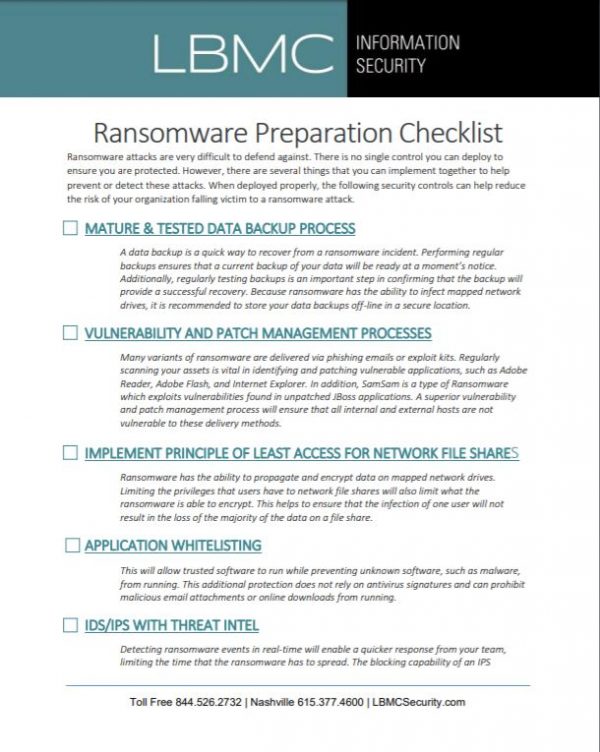
Ransomware Checklist
Includes detailed steps your organization can take to defend against ransomware.
Cybersecurity Insights — Delivered to Your Inbox
Stay informed on emerging threats, evolving compliance requirements, and practical strategies to strengthen your organization’s security posture.
What you’ll receive:
- Cybersecurity trends, threats, and risk insights
- Compliance updates across frameworks like HITRUST, CMMC, SOC, and NIST
- Practical guidance from LBMC cybersecurity advisors
- Invitations to webinars, events, and new resources
Why Choose LBMC for Technical Security Services?
LBMC combines deep technical expertise with practical business judgment to help organizations identify meaningful risks and act on them. What sets LBMC apart:
- Experienced penetration testing, forensic, and incident response professionals
- GIAC-certified expertise in offensive security and incident handling
- Findings prioritized by exploitability and business impact
- Practical remediation guidance, not just technical observations
- Experience across complex and regulated environments
- Coordinated support across Cybersecurity Risk Management and IT Security Compliance & Assurance Services
- Optional retesting to confirm that remediation efforts were effective
Industries We Support
Organizations that depend on secure technology environments need confidence that their defenses are working as intended. LBMC provides technical security services for healthcare organizations, manufacturers, technology companies, government contractors, and other organizations looking to identify vulnerabilities, validate security controls, and improve resilience against evolving cyber threats.
Featured Industries
Local Expertise, Wherever You Are
With offices in Chattanooga, Memphis, Louisville, Nashville, Knoxville, Philadelphia, and Charlotte, plus remote offices, LBMC partners with businesses across the region and beyond.
Technical Security Resources
Explore practical guidance from LBMC’s technical security professionals covering penetration testing, application security, incident response, network security, and strategies for identifying and reducing technical risk.
- Understanding Penetration Testing: A Comprehensive Guide
Learn how penetration testing identifies vulnerabilities through real-world attack simulations and helps strengthen your organization’s security posture. - Optimize Internal Network Pen Tests: Essentials and Tips
Discover why internal network penetration testing is essential for identifying insider threats and improving network security. - The Art of Physical Penetration Testing
Explore how physical penetration testing uncovers weaknesses in facilities, processes, and physical security controls. - How to Respond When a Security Breach Occurs
Understand the critical steps organizations should take following a security incident to reduce damage and support recovery. - Top 11 Windows Security Events to Monitor
Learn which Windows security events should be monitored to detect suspicious activity and strengthen your security operations. - IDS vs. IPS: How Each System Works and Why You Need Them
Understand the differences between intrusion detection and intrusion prevention systems and how they work together to protect your environment.
FEATURED INSIGHT
A Guide to Application Security Assessments

Web applications are frequent targets for cyberattacks, making proactive testing essential. Learn how application security assessments identify vulnerabilities, reduce risk, and help protect your organization before attackers find weaknesses.
FAQs About Technical Security Services
What is the difference between a vulnerability assessment and a penetration test?
A vulnerability assessment identifies known weaknesses across systems, applications, or internet-facing infrastructure. A Penetration Test goes further by attempting to exploit those weaknesses and demonstrate how an attacker could gain access, move through the environment, or affect operations.
Organizations often use an External Vulnerability Assessment to identify broad exposure and penetration testing to validate real-world exploitability.
How often should an organization perform penetration testing?
Many organizations perform a Penetration Test annually, after major infrastructure or application changes, or when required by customers, regulators, or cyber insurance providers.
Additional testing may be appropriate following cloud migrations, acquisitions, significant software deployments, or major changes to identity and access systems.
What is an incident response retainer?
An Incident Response retainer gives an organization access to experienced responders before an incident occurs. It can help accelerate investigation, containment, evidence preservation, and recovery while reducing delays during a high-pressure event.
Retainers may also include readiness planning, documentation review, tabletop exercises, and coordination with internal stakeholders.
When is digital forensics needed?
Digital Forensics may be needed following suspicious activity, unauthorized access, ransomware, insider threats, data loss, or litigation-related events. The process helps preserve and analyze evidence, determine what occurred, assess the scope of impact, and support response or legal requirements.
Why is Active Directory security important?
Active Directory often controls identity, authentication, and privileged access across the organization. Weak credentials, excessive privileges, and insecure configurations can give attackers opportunities to escalate access and move laterally.
An Active Directory Security Assessment helps identify attack paths and prioritize improvements to identity and access controls.
How can organizations evaluate ransomware readiness?
A Security and Ransomware Assessment evaluates whether an organization can prevent, detect, contain, and recover from a ransomware attack. The assessment may examine technical controls, incident-response processes, backups, access management, and coordination across business and technology teams.
How do technical security services support compliance?
Technical testing can help validate whether security controls are operating effectively rather than existing only in policies or documentation. Services such as Penetration Testing, External Vulnerability Assessments, and Active Directory Security Assessments can support broader IT Security Compliance & Assurance Services and framework-specific requirements.
How should technical security be incorporated into technology modernization?
Cloud migrations, new applications, integrations, and system replacements can introduce new vulnerabilities and access risks. LBMC’s Cybersecurity team can work alongside Business Technology, Integrations & Software Development, and Data Modernization Services to evaluate security throughout major technology initiatives.
Meet Our Technical Security Leaders
Our technical security professionals help organizations identify exploitable vulnerabilities, investigate cyber incidents, and strengthen defenses through practical testing, forensic analysis, and remediation guidance.



Let’s Talk About Your Technical Security Needs
Whether you’re preparing for a penetration test, strengthening your incident response capabilities, or evaluating ransomware readiness, LBMC can help you identify risks and take the next step. We’ll start with a conversation focused on your environment, priorities, and security goals.